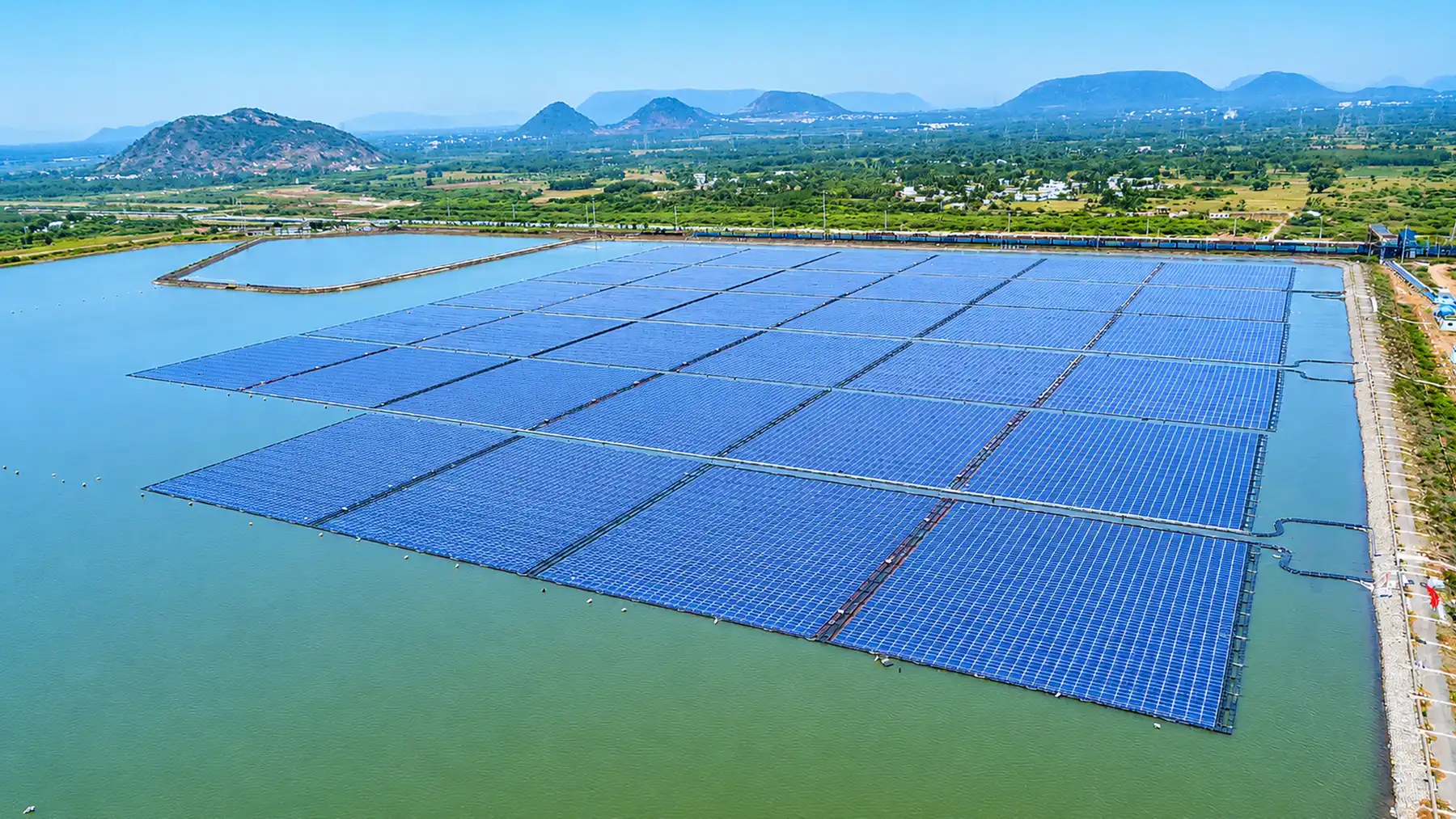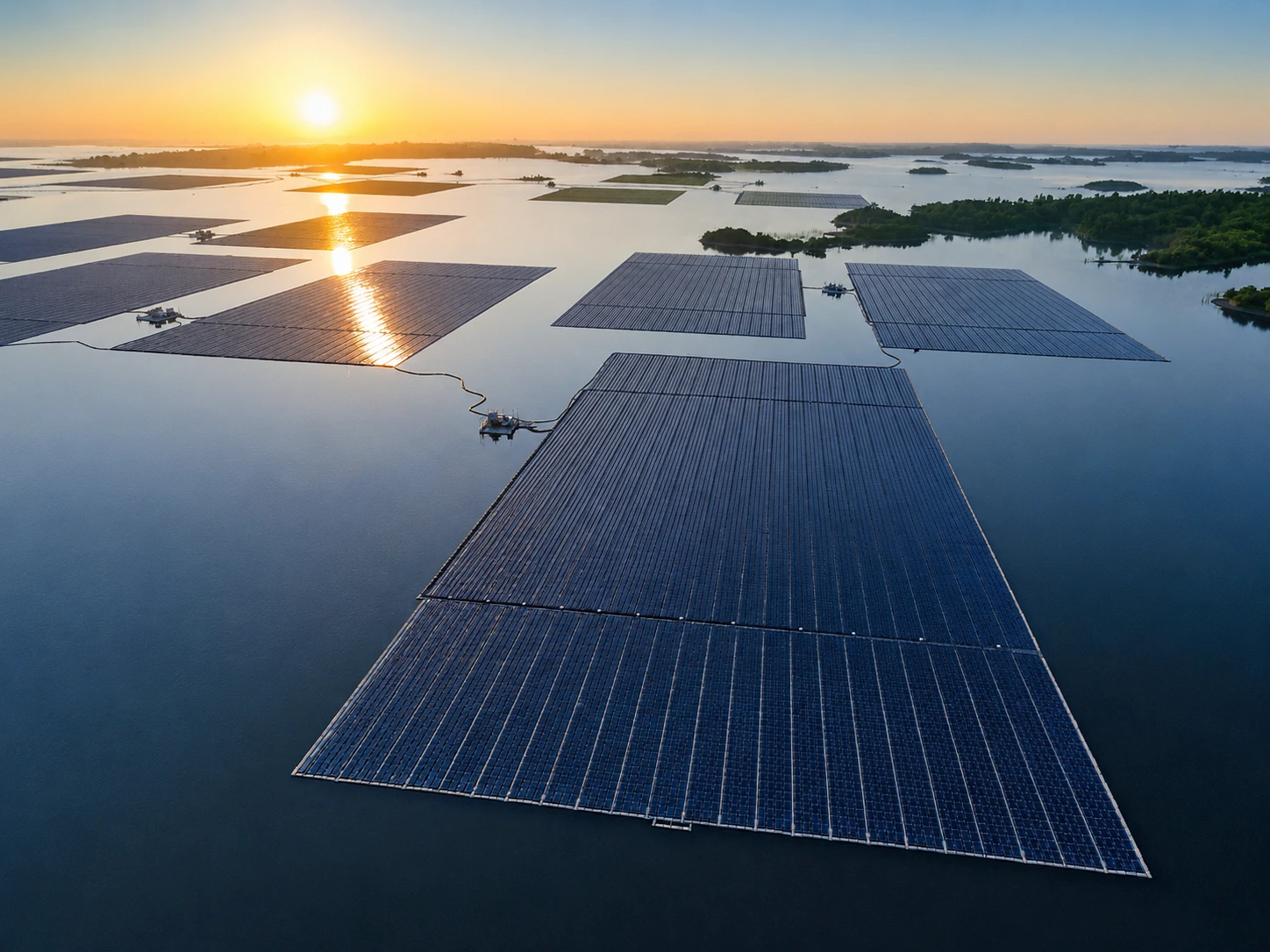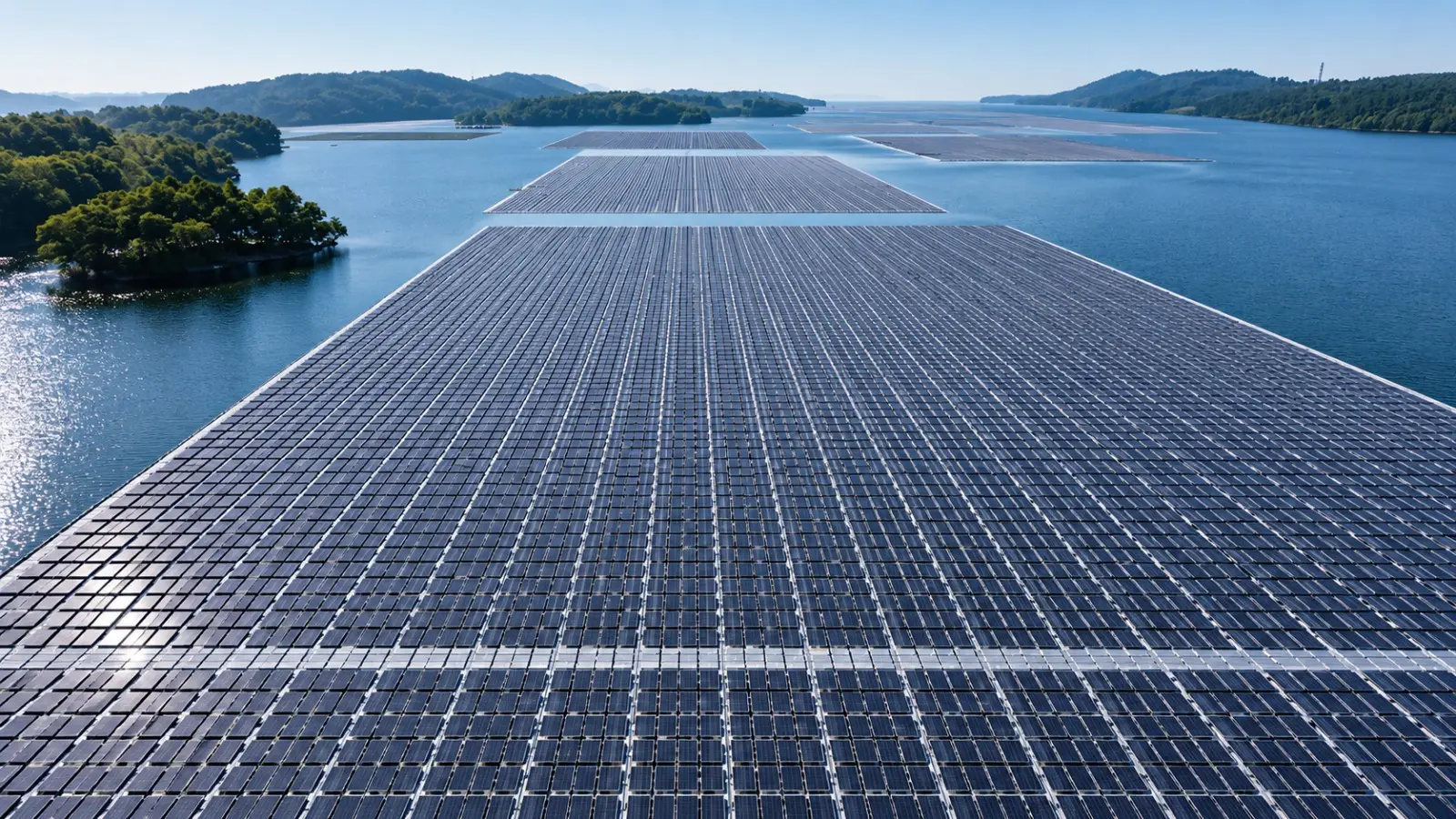
Large-scale floating solar projects do not struggle because floating solar is a new technology. The trouble is that assumptions which worked at small scale start to break down as arrays are built across large water surfaces, and as multiple systems are forced to act as one.
Past a certain size, floating solar stops behaving like a collection of modules on water and begins to behave like floating infrastructure. Layout choice affects structural response, anchoring affects electrical reliability, and construction sequencing reveals weak areas that never appeared on drawings. It is no longer a question of selecting the right components — it is a matter of system behaviour.
This blog dives deep into some of the common engineering challenges faced by large-scale floating solar projects.
When Array Size Starts Dictating Behaviour
At small scale, the behaviour of arrays can be deduced from the performance of an individual float and module. At large scale, behaviour is often dictated by geometry, exposure differences, and cumulative tolerances. What changes first is not capacity, but predictability.
Common effects seen as array footprints increase:
- Differential movement between exposed and sheltered zones
- Load redistribution across interconnected blocks
- Compounding alignment drift
This is seen in massive open-water systems like the NTPC Kawas floating solar installation, where there is a large difference in wind exposure across the array. Even layouts that are symmetrical on paper react asymmetrically in action.
On the contrary, installations with constrained geometries — such as the BHEL-NTPC Simhadri project — reveal another constraint: behaviour is determined by geometry rather than exposure. Here, array response is dominated by boundary conditions.
The shared lesson is that at scale, array behaviour is discovered through interaction, not assumed from component data.
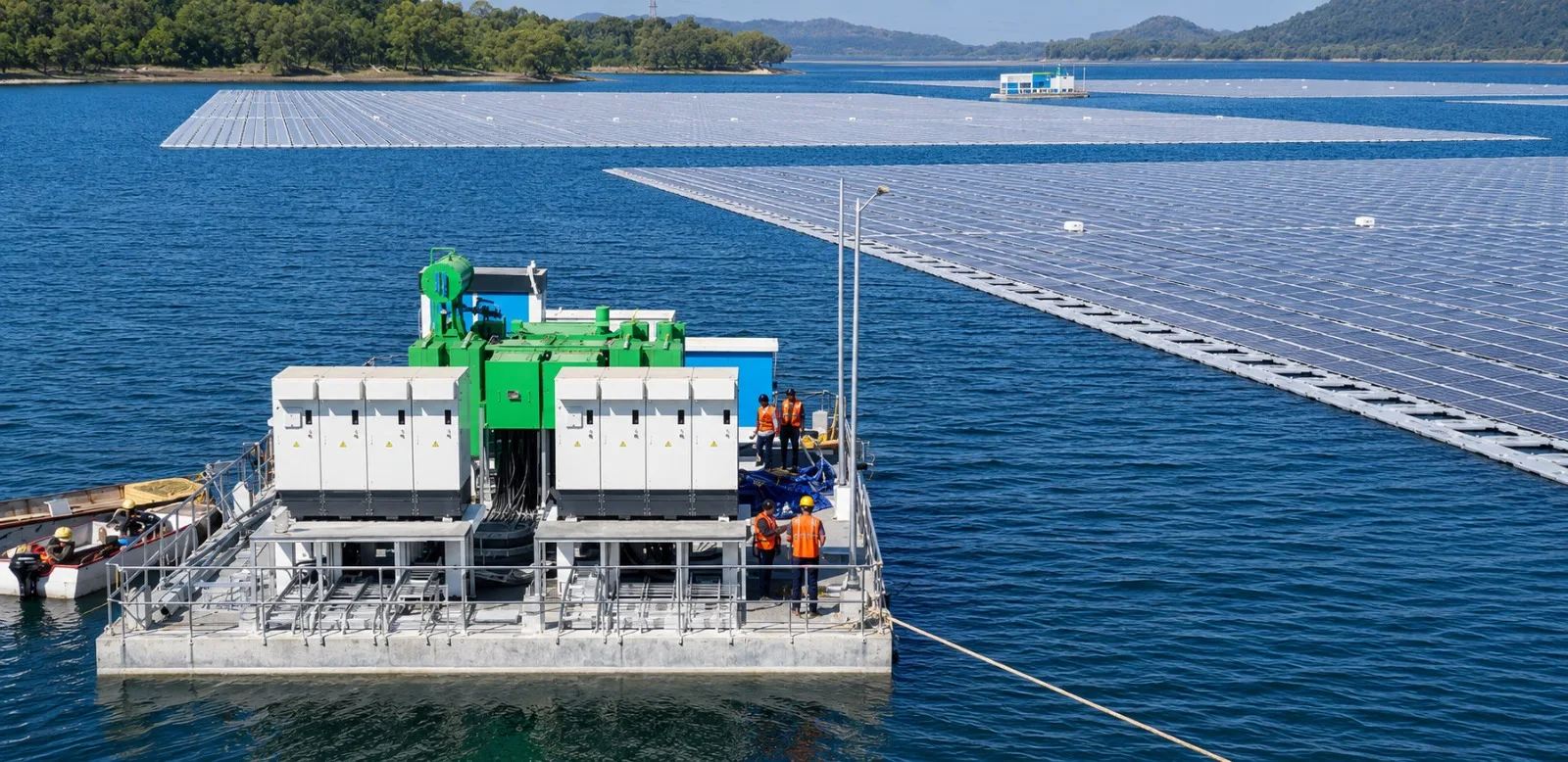
Anchoring: Where "Safe" Designs Become Risky
Systems that seem conservative during the design phase often become the first long-term risk in large floating solar projects. Failures rarely occur due to anchor pull-out; they occur due to fatigue, restraint mismatch, and load transfer issues.
Typical anchoring failure drivers at scale include:
- Over-restraining the array to eliminate movement
- Uneven load sharing between mooring lines
- Fatigue accumulation at connectors and terminations
In compact industrial ponds such as the Dalmia Cement floating solar project, spatial constraints limit anchor placement. Over-constraining the system may reduce visible movement, but it increases cyclic stress in mooring lines and interfaces.
The need to be predictable takes precedence in industrial, safety-critical settings such as the BPCL Kochi refinery installation:
- Controlled movement is preferred over rigid restraint
- Repeatable behaviour is more valuable than minimal material usage
In both situations, anchoring is most effective when developed as a dynamic restraint mechanism rather than a static fixing mechanism.
Floating Platforms Don't Fail — Interfaces Do
In major floating solar projects, the main floating components hardly ever fail individually. Long-run problems almost always start at interfaces:
- Platform-to-platform joints
- Hinges and connectors
- Transitions between structural blocks
As arrays grow, thousands of connections accumulate small tolerances. These tolerances stack up due to differential movement and create local stress concentrations that cannot be seen in the design.
This is especially visible in projects such as Simhadri, where access and walkability are essential, and maintenance safety is directly influenced by platform behaviour. In large arrays like Kawas, the sheer number of interfaces exposes the system to:
- Fatigue at joints
- Progressive misalignment
- Localised damage spreading system-wide
At this scale, interface behaviour is what determines durability. Material choice matters, but the design of the connection and its ability to accommodate movement matter more.
Electrical Systems Are the First to Feel Movement
Electrical problems emerge before structural concerns in most large floating solar projects. This is not because electrical systems are weaker, but because they are less tolerant of uncontrolled movement.
Electrical stress manifests itself at:
- DC cable transitions between floating blocks
- Floating-to-fixed infrastructure interfaces
- Junction boxes subjected to cyclic movement
This is seen in seasonal waterbody projects like the Avaada power plant at Darbhanga. The cyclic movement brought about by repeated water-level changes causes electrical fatigue to build up before any structural distress is visible.
Key electrical lessons at scale:
- Cable routing decisions lock in early
- Movement must be explicitly designed for, not assumed away
- Structural and anchoring behaviour directly affects electrical reliability
Large floating solar acts like a distributed solar photovoltaic power plant, with no dividing line between mechanical behaviour and electrical performance.
Construction Is Where Design Assumptions Get Exposed
Construction is where theory is put to the test by reality. Assumptions that seem reasonable on the drawing board are proved false again and again when put into actual practice on the water.
Typical pressure points during the construction stage are:
- Alignment drift during phased installation
- Stability loss before full anchoring is complete
- Limited scope for correction in constrained sites
In tightly bounded industrial projects such as the Jindal Hisar installation, early alignment errors can cascade into:
- Electrical rework
- Reduced generation efficiency
- Long-term operational inefficiencies
This is why construction feasibility has to influence design. Systems that are hard to assemble are seldom reliable to operate.
Design for Assembly
Systems that are hard to assemble are seldom reliable to operate — at scale, construction feasibility must shape the design itself.
Conclusion
Massive floating solar initiatives succeed when they are approached not as assemblies, but as infrastructure. Scale adds behaviours that cannot be addressed with optimal components alone. Anchoring, platforms, electrical systems, construction sequencing, and operations all have to be designed as a single system — with a clear view of how that system will behave over time.